|
|
|
Has Artist/Author Ananda Leeke's work made a difference
in your life this year? If yes, then click on the PayPal button above
and make a donation to Kiamsha.com, LLC, Leeke's healing arts company. PayPal offers Visa, MasterCard, and American Express
secured payment options. It also offers a PayPal card that you can use for other purchases. Many thanks
in advance for your gift. It is greatly appreciated!
Kiamsha.com, LLC promotes creativity through coaching
and expressive arts, teaches contemplative practices (i.e. yoga, Reiki healing touch, meditation, breathing exercises, journaling,
affirmations, and prayer), and builds community that awakens your soul and transforms your life.
|
 AKOMA is a Ghanaian Andinkra symbol that represents the heart and
means keep an open heart filled with compassion.
"Love is patient, love is kind. It does not envy, it does not boast, it is not proud It
is not rude, it is not self-seeking, it is not easily angered, it keeps no record of wrongs. Love does not delight in evil,
but rejoices with the truth. It always protects, always trusts, always hopes, always perseveres. Love never fails." 1 Corinthians 13:4-8
WHAT IS LOVE'S
TROUBADOURS?
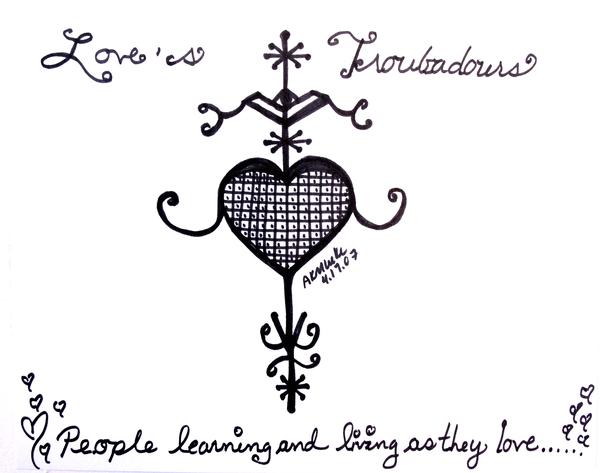
Love's Troubadours is a healing fiction series that features stories told by people who are learning and living as they
love. The healing fiction series is deeply rooted in the storytelling traditions of the West African griot and troubadours
of the French Middle Ages. To learn more about these traditions, read the sections below.
 Senegalese Griot, 1890
WHAT IS A GRIOT?
A griot is a West African poet, storyteller, historian, advisor, arbitrator, and wandering musician
who serves as a repository of oral history tradition. They are walking history books who memorize traditional songs and teachings,
folktales, cultural history, and family relationships. This information is passed down through generations. Griots Griots
also marry them with current events and chance incidents to create praise songs and stories with wisdom teachings, comic relief
and satire, political comment, and gossip. Today, griots live in Senegal, Mali, Gambia, and Guinea. They are present among
the Wolof, Serer, Mande, Malinke, Bambara, Fula, Tukuloor, Wolof, and Mauritanian people. There are several African names
for griots including jeli (a word that means "blood in the Manika language that is derived from ; northern Mande areas),
jali (southern Mande areas), guewel (Wolof), gawlo (Pulaar, a Fula language), and igiiw ( Hassaniyya, an Arabic language).
WHAT IS A TROUBADOUR?
Troubadour is derived from an Old French word "trobador" which comes
from the verb "trobar" that means to invent or compose. When you put it all together, troubadour refers to a composer
and performer of lyric poetry. The French Middle Ages (1100-1350) gave birth to the troubadour tradition in the eleventh century.
The tradition defined troubadour lyric as poetical, rhetorical, and musical fiction. They dealt mainly with themes of courtly
love, chivalry, nature, life, and death. Most troubadour lyric were metaphysical, intellectual, and formulaic. They also included
many genres including alba (morning song - the song of a lover as dawn approaches, often with a watchman warning of the approach
of a lady's jealous husband), canso or canço (the love song, usually consisting of five or six stanzas), dansa
or balada (a dance song with a refrain) ensenhamen (a long didactic poem, usually not divided into stanzas, teaching a moral
or practical lesson), enuig (a poem expressing indignation or feelings of insult), escondig (a lover's apology), partimen
(a poetical exchange between two or more poets in which one is presented with a dilemma by another and responds), planh (a
lament, especially on the death of some important figure), salut d'amor (a love letter addressed to another, not always
one's lover), and tenso (a poetical debate which was usually an exchange between two poets, but could be fictional).
|
|
| ODO NNYEW FIE KWAN is a Ghanaian Andinkra symbol that means the power of love. |
|